| Summary of SCERT Assam D. El. Ed. Admission 2026 | |
|---|---|
| Name of the Organization | State Council of Educational Research and Training(SCERT), Assam |
| Type of Entrance Test | Pre-Entry Test (PET)-2026 |
| Admission Process Starts From | 07/08/2026 |
| Official website | scert.assam.gov.in |
| Join us on | Telegram |
| Join us on | |
SCERT Assam D. El. Ed. Result 2026 – Admission Dates
The SCERT Assam D.El.Ed. Result 2026 for the Pre-Entry Test (PET) 2026 is expected to be declared online on 27th July, 2026 through the official SCERT PET portal. Candidates who appeared in the PET entrance examination will be able to check their scorecard, qualifying status, and district-wise merit position by logging in with their registration credentials.
The result will determine eligibility for the online counselling and seat allotment process for admission into the 2-Year Diploma in Elementary Education (D.El.Ed.) course for the 2026–2028 academic session. Candidates are advised to download and print their result for future admission formalities. For the latest updates on the SCERT Assam D.El.Ed. Result 2026, merit list, counselling schedule, and admission process, keep visiting Assam Job Alert regularly.
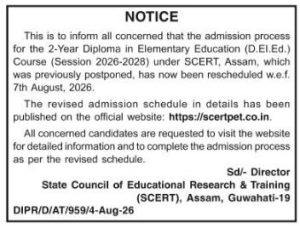
This is to inform all concerned that the admission process for the 2-Year Diploma in Elementary Education (D.El.Ed.) Course (Session 2026-2028) under SCERT, Assam, which was previously postponed, has now been rescheduled w.e.f. 7th August, 2026. The revised admission schedule in details has been published on the official website: scertpet.co.in.
SCERT Assam D. El. Ed. 2026 Details:
Name of the Exam: Pre-Entry Test (PET) 2026
Conducting Authority: State Council of Educational Research and Training(SCERT), Assam
Name of course: D.El.Ed.
No of Available Seats: 4150 Seats
Exam Mode: Offline (OMR-based)
Entrance Exam Date: 12/07/2026
Entrance Exam Type: OMR Based
Date for Declaration of SCERT PET Result : By 27th July 2026
SCERT Assam D. El. Ed. Course 2026 Admission Dates
Revised Schedule for admission process of 2-Year Diploma in Elementary Education (D.EI.Ed.) course for the session 2026-2028
| Sl. No. | Description | Date |
|---|---|---|
| 1 | Result of allotment of institute – Round 1 & cut off mark. | 06-08-2026 |
| 2 | Admission with document verification in the allotted institute with payment of admission fees. | 07-08-2026, 10-08-2026 & 11-08-2026 |
| 3 | Online submission of admission report and vacancy list by the respective institutes. | 12-08-2026 (Before 5.00 PM) |
| 4 | Publication of vacancy list. | 13-08-2026 |
| 5 | Result of allotment of institute – Round 2 & cut off mark. (Subject to availability of seats) |
14-08-2026 |
| 6 | Admission with document verification in the allotted institute with payment of admission fees. | 17-08-2026 |
| 7 | Online submission of admission report and vacancy list by the respective institutes. | 18-08-2026 (Before 5.00 PM) |
| 8 | Publication of vacancy list. | 19-08-2026 |
| 9 | Online counseling (2nd phase) for revision/modification of preferences of Teacher Education Institutes (TEIs) by the candidates. (Subject to availability of seats) |
20-08-2026 |
| 10 | Result of allotment of institute – Round 3 (Last Round) & cut off mark. | 24-08-2026 |
| 11 | Admission with document verification in the allotted institute with payment of admission fees. | 29-08-2026 |
| 12 | Online submission of admission report and vacancy list by the respective institutes. | 31-08-2026 (Before 5.00 PM) |
| 13 | Publication of vacancy list. | 01-09-2026 |
Spot admission will be held in the institutes tentatively w.e.f. 03-09-2026 to 10-09-2026 subject to availability of seats. (Detailed schedule along with Notice will be published on 02-09-2026).
Eligibility Criteria for SCERT Assam D. El. Ed. 2026
Minimum Educational Qualification: The candidates must have passed Higher Secondary (HS) [10+2] from recognized Board/Council with at least 50% marks in aggregate excluding marks secured in the optional/extra/fourth subject. For candidates belonging to SC/ST(P)/ST(H) category there will be relaxation of 5% of marks in aggregate excluding marks secured in the optional/extra/fourth subject.
Locality: The candidate must be a permanent resident of Assam.
Age: The candidate must not be less than 18 years and not more than 34 years as on 1st July, 2026. There will be relaxation by 2 years in upper age limit for candidates belonging to SC, ST(P) & ST(H) categories.
Reservation: Reservation of seats for the candidates belonging to reserved categories including OBC/MOBC, SC, ST(P), ST(H), Person with Disability (PWD), EWS will be as per Reservation Policy.
How to Chekc For SCERT Assam D. El. Ed. Result 2026
Candidates can check their SCERT Assam D.El.Ed. Result 2026 by visiting the official SCERT PET Result Portal once the results are declared. Click on the “D.El.Ed. PET Result 2026” link available on the homepage and log in using your Application Number and Password/Date of Birth. After successful login, your scorecard, qualifying status, and merit details will be displayed on the screen. Download and take a printout of the result for use during the counselling and admission process.
Syllabus and Marks distribution for SCERT Assam D. El. Ed. 2026
- The Test shall have Two Sections : Section-l and Section-II
- Total Marks : 100
- Time : 2 hours
- Type of question : MCQ
- Number of question : 100
- Mark carried by each question : 1
Section-I:
General English: vocabulary, tenses, verbs, preposition, comprehension, voice-change, narration, adverbs, synonyms, antonyms.
General Knowledge: Current affairs, who is who, abbreviations, constitution of India, History of Assam, Inventions and discoveries, Sports. Art and culture, Every day Science, World Organizations, Geography of India, Educational Commissions and Committees, New Educational Initiatives, Educational Organizations.
Reasoning: Logical and analytical reasoning, pattern etc.
| Section-l | Marks |
| General English | 10 Marks |
| General Knowledge | 15 Marks |
| Reasoning | 10 Marks |
Section-II:
A. Mathematics:
- Numbers: Natural, whole, even and odd numbers, prime and composite numbers, place value, four fundamental operations of number, factors and multiples, prime factors, LCM and HCF, ascending and descending order.
- Fractions: Concept of fraction and its uses.
- Percentage: Concept of percentage, solving problems involving percentage, profit and loss.
- Money: Concept of money, solving problems involving money.
- Geometry: Angles, types of angles, types of triangle, types of quadrilateral, circle.
- Measurement: Length, area, volume and perimeter of different geometrical figures, Measurement of weight and time.
- Data handling: Representation of data, bar diagram, Pie diagram.
- Square & square root: Concept of square root, solving problems involving square root.
- Ratio and proportion.
- Simple algebraic equation.
B. Science & Environmental Science
- Natural and Social Environment.
- Factors influencing environment.
- Causes of environmental degradation: Air, water, sound and soil pollution. Bio-diversity.
- Environmental Issues: Flood, erosion, earthquake, deforestation, population explosion.
- Environmental protection- Constitutional provision, Protection Acts, Role of individual and local bodies, NGOs and Government.
- Different states and characteristics of matter, physical and chemical change.
- Chemical reaction.
- Force, energy, motion.
- Cell–Plant and animal cell, structures.
- Adaptation in plants, reproduction in plants.
- Microorganism. Heat and temperature, measurement of temperature.
- Acid, Bases and Salt. Light and Reflections.
- Weather and climate.
- Respiration in organism and in plants.
C. Social Science:
- Natural and human resources.
- Atmosphere and its different layers.
- Freedom movement of India and role of India.
- Constitution of India and its importance.
- Democracy and its principles.
- Rise and fall of Ahom kingdom.
- Ancient urban civilization.
- Government: State and Central.
- Earth and its structure.
- Consumer protection and right.
- Role of financial institutions in socio economic development of the society.
- Transport and communication.
- Agricultural and Industrial development.
- India after independence.
- Contribution of medieval administrators on socio economic development in Assam.
D. Language:
- 30 Objectives of Language learning.
- Importance of language learning.
- Application of phrases and idioms.
- Skills of language learning (listening, speaking, reading and writing skill).
- Methods of language teaching.
- Difference between home language and mother tongue.
- Suffix, prefix, gender, coalescence of two words according to rules of grammar (sandhi).
- The verb and number (singular and plural).
- Reading Comprehension Test.
- Nattabidhi, Sattabidhi.
Important Date and Links For SCERT Assam D. El. Ed. 2026
| Seat Allotment Result of Round 3 | Click Here |
| For Admission Dates | Click Here |
| Check Result | Click Here |
| Merit List | Click Here |
| Online Apply Link | Click Here |
| Official Notification | Click Here |
| Admit Card | Click Here to Download |